Direct Colony Sequencing

Direct Colony Sequencing Service


Fast
Receive your sequencing results one day earlier for your plasmid clones as DNA preparation is not needed. Results are available 15 hours after samples received

Convenient
With our PlateSeq Kit Colony you get all the accessories you need to ship your bacterial colonies either from agar colonies or as liquid culture

Cost-Effective
Reduce your expenses on plasmid DNA isolation and let us sequence your bacterial colonies directly


Direct sequencing of bacterial colonies by rolling circle amplification (RCA).

The Direct Colony Sequencing service uses rolling circle amplification to enable fast sanger sequencing of plasmid clones in 96well plates without the need for plasmid preparation.


Product Selection

PlateSeq Kit Colony - The prepaid option for the Direct Colony Sequencing service


PlateSeq Kit Colony

PlateSeq Kit for direct colony sequencing

With the PlateSeq Kit Colony you buy:

  • A labelled white 96 well PCR plate
  • Filled with appropriate TE buffer*
  • 96 prepaid sequencing reactions
  • Twelve 8-cap strips for secure sealing
  • Shipped in our plate sample box

*TE buffer is stable for ~ 3 years stored at room temperature.

Product Code: 3094-000CSP

PlateSeq Coupons

PlateSeq Coupons for additional reactions

PlateSeq Coupons are provided electronically.

They can be used to prepay additional reads along with
the PlateSeq Kit Colony.

Product Code: 3094-00ONPM

Prepaid plate kits and coupon codes remain valid for three years from the date of ordering, after which they expire. You can opt to receive an email notification before any of your prepaid Sanger products expire by specifying it in your personal preferences.


Details about our Direct Colony Sequencing service 


  • Available for E.coli colonies or any other gram negative bacteria
  • Up to 4 reactions per sample, per plate are possible
  • High quality read lengths of up to 1,100 bases
  • Results are available 15 hours after samples received
  • Free one time repetition in case of technical failure*
  • Different sequencing result files can be selected per order
  • A huge amount of standard primers are available free of charge
  • Sequencing primers can be ordered or enclosed
  • Easy re-order options from stored DNA samples


Introduction


You have prepared your DNA construct, cloned it into a vector and transformed E. coli with it. Now it is time to pick and grow the colonies and conduct minipreps in order to extract plasmids to send for sequencing. Confirmation of a construct’s presence and identification of the construct in the vectors is absolutely essential before you continue to work with the plasmids. However, this process is quite laborious and time-consuming, especially when there are a large number of colonies to check.


You can save time by using the Direct Colony Sequencing solution. This Sanger sequencing service in 96-well plates conveniently sequences the plasmids/vectors directly from bacterial colonies without the need for plasmid preparation.


You just need to pick the colonies and directly transfer them to the 96-well plate that comes with the service. The wells of this plate contain buffer to preserve the colonies.


This fast and cost-effective solution can be used to quickly screen your DNA cloning experiments and select the candidate(s) for final confirmation via DNA preparation and sequencing.
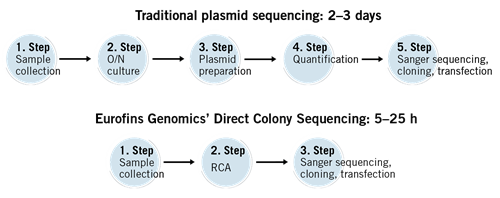


What is the basis of Direct Colony Sequencing and why does this sequencing solution work without plasmid preparation?


Rolling circle amplification process

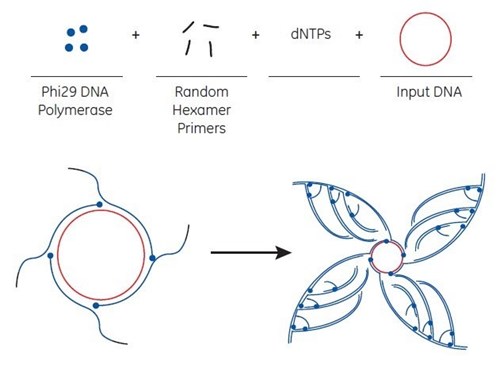
The basis for the Direct Colony Sequencing solution is the rolling circle amplification (RCA) technique that generates multiple copies of circular DNA.


The rolling circle amplification (RCA) method utilises bacteriophage Phi29 DNA polymerase to exponentially amplify single- or double-stranded circular DNA templates. The isothermal amplification method produces microgram quantities of DNA from picogram amounts of starting material in a few hours.


An in vitro amplification of very small amounts of template DNA eliminates the need for overnight cell culture and conventional plasmid or M13 bacteriophage DNA purification. The proofreading activity of the Phi9 DNA polymerase ensures high fidelity DNA replication.


Starting material

The starting material for amplification can be of various sources, such as from a small number of bacterial cells containing a plasmid, isolated plasmids and intact M13 phages to any circular DNA (including ligation reactions).

Bacterial colonies can be picked from agar plates and added directly to the 96-well plate. Alternatively, microlitre quantities of a saturated bacterial culture or a glycerol stock can also serve as starting material.


Process

RCA is performed at 30°C without thermal cycling. Depending on the source of starting material, amplification is completed in 6 to 18 hours. The amplification products are double-stranded concatemers of the circular template with high molecular weight. Concatemers are large DNA molecules that contain many copies of a specific DNA sequence.

For RCA, random hexamer primers anneal to the circular single-strand template DNA at multiple sites. The Phi29 DNA polymerase extends each of these primers. When Phi29 reaches a downstream extended primer, strand displacement synthesis occurs. Here, the original single-stranded DNA is replaced by the newly replicated strand. The displaced strand is then available to be primed by more hexamer primer. The process results in exponential amplification.

Note: when starting with M13 bacteriophage clones, the product is double-stranded DNA and can be sequenced with forward and reverse primers. DNA amplified by the method can be used directly without any purification.


The Direct Colony Sequencing service has been validated primarily for plasmids in E. coli colonies. In principle, the method also works with large constructs (e.g. BACs) and other organisms. Contact us for pilot testing and optimisation. As a starting point, we recommend performing cell lysis or crude DNA extraction and adding 1 to 5 µL of the lysate/extract to the buffer in the 96-well plates.


References

Dean, F. et al., Genome Research 11, 1095–1099 (2001).

Lizardi, P. et al., Nat. Genet. 19, 225–232 (1998).

Estaban, J.A. et al., J. Biol. Chem. 268, 2719–2726 (1993).


Sending samples the right way for our Direct Colony Sequencing service

  • Please order our PlateSeq Kit Colony first (It contains the approptiate buffer)
  • Shortly centrifuge the received plate to avoid the liquid on the foil. Carefully remove the sealing foil from the plate
  • Grow your colonies on agar plates long enough to have a colony diameter of at least 1 mm*
  • Use a toothpick to take as much of the bacterial colony as possible and inoculate into our plates. Swirl the toothpick for some seconds to transfer as many cells as possible into the wells
  • In case of bacterial suspension use a pipette to add 5µl of the liquid culture in each well
  • Well H12 should be kept empty for internal quality control
  • Seal your plates using 8-cap strips to prevent material loss (8-cap strips are provided along with each PlateSeq Kit Colony)
  • Plates can be sent / provided at ambient temperature to our sequencing lab


Important:

For any type of bacterial clones / colonies that are living cells and genetically modified organisms, this GMO form must be, in accordance with the Genetic Engineering Recording Ordinance GenTAufzV (§3 No. 10 GenTG), filled, signed and enclosed with your shipment.


*We recommend to create a replica of your E.coli colonies right after growing. Use the same toothpick to inoculate LB media containing antibiotics to produce an overnight culture or streak out on a fresh agar plate.


Thanks to our DNA synthesis lab, bioinformatic know how and internal IT solutions you can choose how to provide us with your sequencing primers:

  • Select from standard primers on stock
    Select and manage your favourite standard primers from more than 80 different validated standard primers
  • Order specific sequencing primers
    Specific primers can be ordered directly with your sequencing order. These primers are stored for 4 weeks ( One year on request) and can be re-used during this time
  • Enclose your own sequencing primers
    You can send us your sequencing primers in 1.5ml tubes along with your samples by using our free Primer Barcodes. Enclosed primers are stored for 10 days. 


Please consider optimal primer conditions, concentration and volume as described below.


Optimum primer conditions:

  • Primers must not contain phosphorylation or fluorescent dyes
  • The optimum primer length is between 16-25 bases
  • The primer melting temperature (Tm) should be 50 - 62°C
  • The GC content of the primer should be 35-60%
  • Ideally one G or C should be located at the 3' primer end
  • The number of 3' Gs or Cs should not exceed 2 Gs or Cs
  • If possible, avoid >3 identical bases in a row in the sequence


Primer concentration and volume for enclosed primers:

  • Exactly 10 pmol/µl primer concentration is required per sequencing reaction
  • Each primer must have a total volume of 20 µl (double distilled water or 5mM Tris-HCl); 2 µl of primer volume is required for every additional sequencing reaction
  • Concentration of primers with wobble bases must be calculated according to the following formula: nX x ConcPrimer

n = number of bases within a wobble according to IUPC code, X = number of wobbles within the primer sequence. [e.g. 1 V (AGC) = 31 x 10 pmol/µl; 2 Y (CT) (CT) = 22 x 10 pmol/µl; 1 N (AGCT) = 41 x 10 pmol/µl ]


DNA and primer storage:

  • Storage of template DNA for 4 weeks
  • Storage of synthesised primers for 4 weeks free of charge
  • Storage of synthesised primers for one year at additional cost
  • Storage of enclosed primers for 10 days free of charge
  • Storage of enclosed primers for 6 months at additional cost


Data storage:

  • Secure online archive of all selected sequence data for 6 months


Definition of technical failure

A technical failure is defined as a chemical or technical (IT, machines) defect in our lab. In order to ensure that the sequencing quality is not affected by a technical failure, an internal quality is run with each plate (for that purpose well H12 should be kept empty, otherwise a quality control is not possible). In addition to that, a sophisticated software is analysing each plate considering parameters like quality values (QV) and reading lengths. If these parameters fall below a certain percentage across the plate an additional manual check is performed. If a technical failure is confirmed by this manual check, the plate is getting re-sequenced.


Important information:

Specified delivery times are mainly depending on sample arrival time in the lab.

For many European cities we are providing coordinated pick-up and transport services using Eurofins DropBoxes ensuring on time delivery in the lab.

However, these logistics services may also be subject to force majeure or unpredictable changes caused by e.g. strikes, accidents, storms, floods. In such events, Eurofins Genomics cannot guarantee the stated data delivery time and is not responsible for delays caused by logistics services.

Additionally, our general terms and conditions (GTCs) apply.


Useful accessories for the Direct Colony Sequencing service


Primer Barcodes for enclosed primers

Free barcode labels for labelling enclosed primers in tubes.


8-Cap Strips


For secure closing of liquid samples and primers in 96well plates

  • 12 clear 8-cap strips
  • For sealing one 96well plate
     

Tube Bags

Small paper bags for shipment of

  • Sequencing samples in tubes
  • Sequencing primers in tubes

Size: 10 × 16 cm
For up to 30 × 1.5 ml or 80 × 0.5 ml tubes.
One package contains 10 bags.